Want to make money running Google Ads? We know how to do it. In this case study, you’ll learn how First Rank dramatically increased the number of conversions for our client by rebuilding their Google Ads Campaign. Our team:
- Eliminated keyword stuffing and replaced it with inviting, human-centric copy
- Launched a Performance Max (PMax) campaign to expand reach while lowering costs
- Used dayparting to adjust our bids based on peak demand
The results: Lower cost-per-acquisition (CPA), higher click-through rates and conversion rates, and better, more qualified leads – all without increasing the total Ads budget.
Sounds like a good deal? Keep reading.
Campaign Overview: Our Client’s Goals And Our Metrics
Our Client
- Is a therapist in Winnipeg
- Was running ads to get more local clients
The Starting Point
- Cost-per-click (CPC) trending up
- Flat click-through rate (CTR)
- Inconsistent call quality
Their Goals
- Reduced cost-per-acquisition (CPA)
- Better quality leads
- A stable, consistent number of leads throughout the week
Our Core Metrics
- CPA/CPL (cost-per-lead)
- Impression shares
- Conversion rates
- Call duration (as a proxy for quality)
- Qualified rate (the rate of high-value leads vs. low-value leads)
Challenges Before First Rank: What Held Their Performance Back
Our client had been running a Google Ads campaign before working with First Rank. They faced several different challenges, which we can divide into three groups:
- Industry challenges
- Landing page challenges
- Ad campaign challenges
Industry Challenges
Finding clients as a therapist can be challenging. Therapists can find that clients don’t reach out to them – and that when they do, the client and the therapist are not the right fit for one another. A consultation call can help improve these problems, but after one or two sessions, a client who was thought to be a good fit may leave.
Finding someone who is looking for a therapist is not enough; there are so many modalities and niches in therapy, and clients are looking for therapists who fit their specific needs. This makes lead quality especially important for therapists.
Landing Page Challenges
Your landing page plays a huge role in determining whether or not clicks become leads. Our client’s landing page needed work; they had:
- No call-to-action (CTA) above the fold
- No trust signals, like testimonials and experience, on the landing page
- Contact information that wasn’t easy to see or access
- Not enough content
Ad Campaign Challenges
On the ads themselves (and the overall campaign), we noticed a few issues:
- The Ad Quality score for most ads was “Poor.”
- The Ad Groups were somewhat disorganized.
- They were not running a Performance Max (PMax) campaign.
- There were no tight controls on CPA spend.
The First Rank Strategy: Three Moves That Changed The Game

Every ad campaign we take on presents its own unique challenges, and while some fundamentals remain constant, a different approach is needed for each client we assist. Here are the three key moves we made to completely revitalize our client’s Google Ads campaign:
- Implementing a number of core tactics that can help any campaign see improved performance
- Working on both copy and campaigns in a two-pronged approach to shore up quality on all fronts
- Using a unique dayparting campaign to secure leads when they matter the most
This sounds simple at first glance, but as with all campaigns our Google Ads agency takes on, there are nuances to each and every step. Below, we’re going to elaborate on many of the techniques we used.
Core Foundations
The foundation of any great Google Ads campaign is research. You must regularly add keywords in order to see what performs best, and you must use negative keywords to avoid low-quality leads. Tinkering with keywords to find the sweet spot for your ads is crucial. Techniques we used for this client include:
- Performing daily Search term reviews
- Adding new keywords to test performance
- Using different match types for the best-performing keywords
- Adding negative keywords to improve lead quality
- Separating Ad Groups by service and keyword to improve Quality Score
Keeping consistent themes in Ad Groups helps to improve keyword-ad copy alignment; in other words, we ensured that the right ads and copy were being displayed for the right searches.
From Robotic To Human: Our Ad Copy Revamp
There can be a tendency to run with very keyword-heavy ad copy when running Google Ads; after all, if there’s a keyword in your copy that matches a keyword used in a search, it stands to reason that Google would be more likely to display your ad.
That would normally be true, but expected click-through rate plays an important role in an ad’s Quality Score; if your ad is keyword dense (and thus relevant) while looking spammy, no one will click it, and it will be less likely to win auctions.
Once we’d successfully created relevant ad groups for the services and keywords we were targeting, we took the time to write human-centric copy; no keyword stuffing, just relevant messages for people who were looking for a therapist. We dramatically improved the Quality Score for these ads, which were ranked as “Poor” before we began our work.
Ad Campaigns Built To Maximize Performance
Our client’s ad campaign saw a number of improvements – you’ll read about two of our favourites in the next section about dayparting and bidding.
Before we dive into those, though, let’s take a moment to talk about Performance Max campaigns. Our client did not have one, and if you don’t either, they’re a campaign type that’s definitely worthy of your consideration.
Performance Max (or PMax) campaigns allow you to:
- Define conversion goals
- Automatically create ads from asset groups
- Display those ads across various Google Ads channels
PMax campaigns are AI-driven, with Google automatically performing multivariate testing to determine what combination of assets is most likely to lead to your conversion goals being achieved.
PMax campaigns give us more insights into performance and how to optimize our other campaigns while extending the reach of each campaign we run. The PMax campaign we implemented for our client bolstered their success, maximizing their reach at a low cost.
The Dayparting And Bidding Optimization Strategies That Secured Us The Win
One tactic we used for our client’s Google Ads campaign is a little-known technique called dayparting.
How often are you searching for lumber at two in the morning? For most of us, the answer is “never.” How often are you looking for pizza places at two in the morning? For many of us, the answer may be more often than we’d like to admit.
Dayparting is a technique that recognizes this reality: People search for different things at different times of day. To help our client improve lead quality, we divided their ad schedule into 2 to 3-hour timeslots, increasing the value of our bids during the best-performing hours each day.
Every week, we look at the previous week’s performance, and the performance of the campaign overall, then adjust our ad schedule and bids accordingly.
Beyond our dayparting strategy, we also added a target cost-per-acquisition (CPA) of $50 in order to control spend while still bidding aggressively enough to beat competitors with our improved Quality Score.
Measurement And Quality Assurance
During our campaigns, we consistently monitor performance. For this client, we used a number of KPIs to ensure that the campaign was trending in the right direction. These KPIs were based on:
- Cost-per-conversion (CPC)
- Total conversions
- Cost-per-click (CPC)
- Number of clicks
- Click-through rate (CTR)
- Quality Score
We also regularly measured keyword performance and our dayparting strategy, changing keywords and bid timing to continuously optimize our campaign.
Along with these metrics, we talked to our client about the leads they were getting; we wanted to ensure our ads were reaching their target clients.
The Results In Pictures
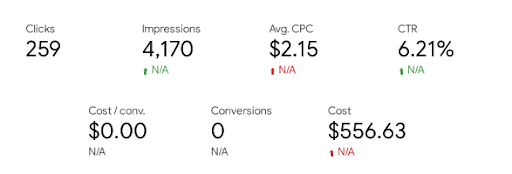
Here is the change to some of the key metrics we were tracking from June 2025 to November 2025:
June 2025:
November 2025:
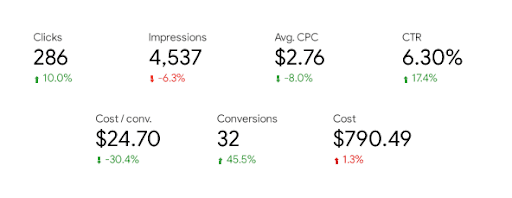
The improvement is remarkable: More clicks, a better click-through rate, more impressions, and most importantly, a dramatic increase in conversions (from 0 to 32).
You’ll notice that the total cost of the campaign increased; that’s okay! Think about it like this: Would you rather spend $556.63 on no leads or $790.49 for 32 leads? For us, the choice is simple – and it’s one our client really appreciated, too.
First Rank’s Google Ads Playbook
Here’s a quick summary of things we did for this Google Ads campaign:
- Monitored keywords constantly
- Added and removed keywords based on performance
- Used negative keywords to eliminate low-quality leads
- Used Google Ads groups strategically
- Spent time on writing copy for humans – not robots
- Ensured that landing pages had:
- A clear CTA above the fold
- Copy and images that demonstrate expertise and authority
- Trust signals
- Contact information that’s easy to access
- Used dayparting to optimize bidding strategy
- Used PMax campaigns to increase reach and multivariate-test
- Thought about the value of a lead, and set a cost-per-acquisition (CPA) that met specific goals
- Used KPIs to ensure that the campaign helped achieve the clients’ goals
How do you get a great CTA? How do you figure out which trust signals to use or what times of day to bid at (and how much)? How do you apply the knowledge you gain from multivariate testing, and what KPIs should you set? We’ve got the experience to answer those questions – and many, many more.
Ready To Turn Wasted Spend Into Qualified Leads?
Anyone can run ads. We make them profitable. First Rank is here to drive leads to your business. Choose us for your Google Ads management.

Jacob Kettner is the owner and CEO of First Rank Inc., a digital marketing agency based in Winnipeg, Manitoba. He currently sits on Manitoba Chamber of Commerce Small Business Advisor Council which assists people grow their small businesses in Manitoba.